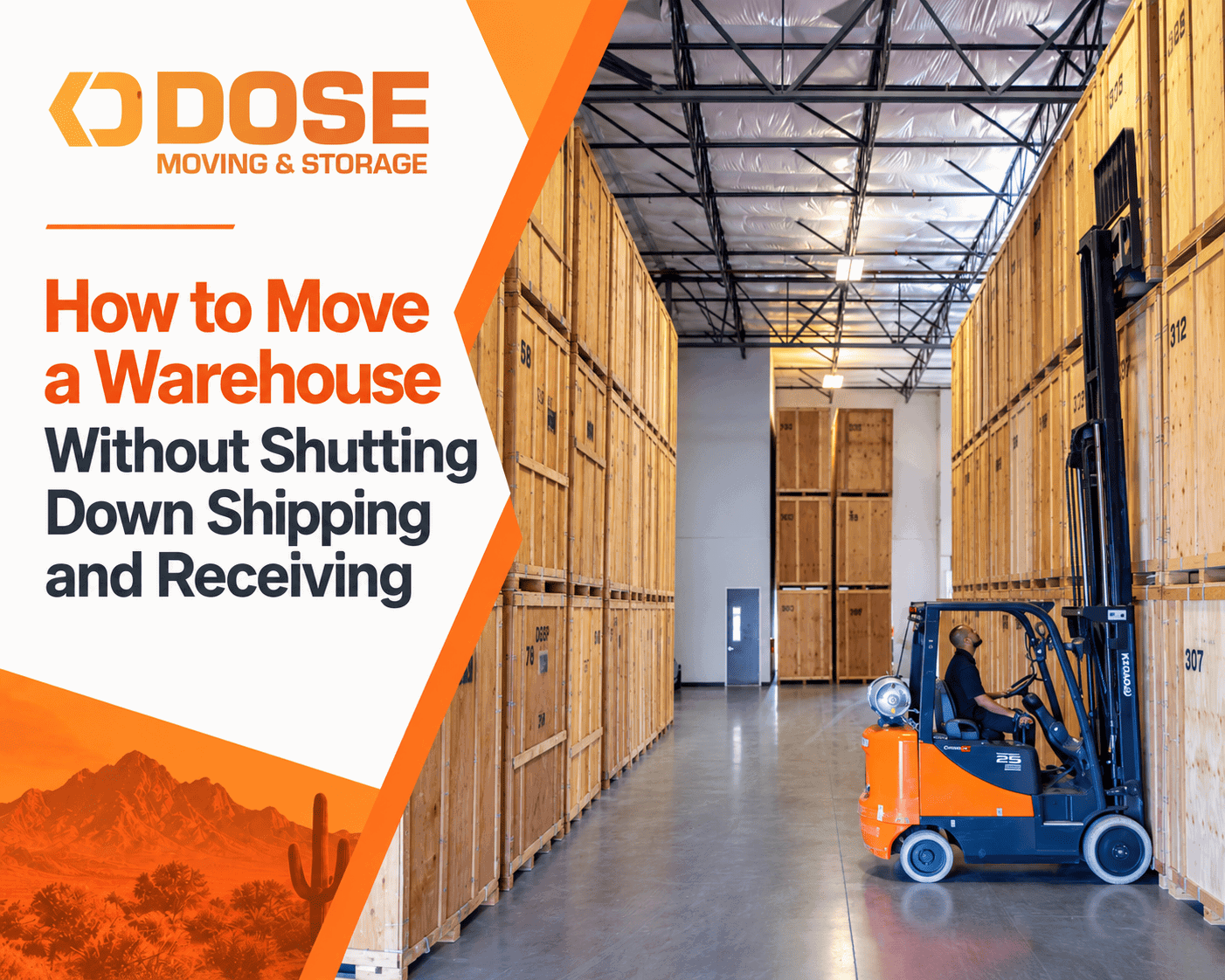
How to Move a Warehouse Without Shutting Down Shipping and Receiving
A warehouse relocation creates a problem an office move never has to deal with. An office can close for a weekend without losing revenue in any measurable way, but a distribution center that stops shipping for even a few days can miss delivery windows, break vendor commitments, and put customer relationships at risk. The pressure to keep operations running during the move is not a preference, it is often the entire constraint that shapes how the relocation gets planned in the first place. A dedicated warehouse and distribution center moving plan is built around that constraint from the start rather than treating it as an obstacle to work around later.
Most warehouse moves that succeed without a shutdown share a similar structure. They break the relocation into phases instead of treating it as a single event, they sequence the racking and inventory moves around what shipping and receiving actually needs day to day, and they build in enough overlap between the old and new spaces to absorb the inevitable delays that come with a move of this scale.
Why a Single Cutover Date Rarely Works
The instinct with any relocation is to pick one date, move everything on that date, and reopen at the new location the next morning. For a small office, this works fine. For a warehouse handling active orders, it almost never does. Racking systems take time to disassemble and reinstall correctly, inventory has to be tracked through the transition without losing visibility on stock levels, and material handling equipment needs to be operational at both ends during the crossover period.
A single cutover date also assumes the new space is entirely ready to receive the full operation on day one, which is rarely the case. Racking installation, dock leveler calibration, and any electrical or network work at the new facility often finish in stages rather than all at once. Trying to force a full operational move before the space is ready creates exactly the kind of downtime a phased approach is designed to avoid.
Phasing the Move Around Operational Priority
The most effective way to avoid a shutdown is to identify which parts of the warehouse can move first without disrupting active operations, and which parts need to stay functional the longest. Slow moving inventory, seasonal stock, and equipment not tied to daily order fulfillment are usually the safest starting point, since relocating them first has minimal impact on shipping schedules while giving the crew and the new space time to work through any early issues.
Fast moving inventory and the racking that supports it typically move last, once the new space has proven it can handle the volume and the team has had a chance to work out any layout adjustments based on what was learned moving the earlier phases. This sequencing means the highest risk part of the operation gets the benefit of everything learned from the lower risk phases that came before it.
Racking and shelving disassembly deserves its own attention within this phased structure. Pallet racking is not simply unbolted and reinstalled anywhere convenient. It needs to go back up in a configuration that matches how the new space will actually operate, which sometimes means the layout at the new facility differs meaningfully from the old one rather than being a direct copy. Planning that layout before the move begins, rather than figuring it out as racking arrives on site, avoids a second disassembly and reinstallation that nobody budgeted time or cost for.
Keeping Inventory Trackable Through the Transition
Inventory visibility is one of the more overlooked risks in a warehouse relocation. It is easy for pallets to become temporarily untracked during a move, particularly when items are staged, loaded, transported, and unloaded across multiple trips over several days. A warehouse that loses track of even a small percentage of its inventory during a relocation can spend weeks afterward reconciling counts that should have been accurate the entire time.
The businesses that avoid this treat inventory tracking as part of the move plan itself rather than an afterthought handled by whoever happens to be available. That means assigning responsibility for scanning or logging inventory as it moves, keeping a clear record of what has been relocated versus what remains at the old facility, and building in a reconciliation check at the end of each phase rather than waiting until the entire move is complete to discover a discrepancy.
Coordinating Material Handling Equipment
Forklifts, pallet jacks, and other material handling equipment present a scheduling challenge that is easy to underestimate. If all of a facility’s equipment moves at once, neither location has functioning equipment during the transition, which stalls both the relocation itself and any operations still running at the old space. Staggering equipment relocation, keeping enough on hand at the origin to support ongoing shipping while the new facility receives its own equipment ahead of the bulk of the move, keeps both ends functional throughout the process.
This is also where the timing of a company’s broader logistics needs comes into play. A warehouse relocation is rarely just about moving from one building to another. Companies managing ongoing distribution needs on top of the move itself often find that 3PL logistics support during the transition period takes pressure off an internal team that is already stretched thin trying to manage a relocation and daily operations at the same time.
Scheduling Around Shipping and Receiving Windows
After-hours and weekend scheduling matters more for a warehouse move than for almost any other type of commercial relocation, because shipping and receiving windows are frequently tied to carrier pickup times and vendor delivery schedules that cannot simply be rearranged around a move date. Identifying which hours of the week see the lowest shipping volume, and concentrating the highest disruption phases of the move into those windows, reduces the chance that a relocation task collides directly with a scheduled pickup or delivery.
For companies operating in the Goodyear area, where much of the Valley’s industrial and distribution activity is concentrated, this kind of scheduling coordination benefits from working with a mover already familiar with the loading dock configurations and traffic patterns common to warehouses in Goodyear, since a crew that has handled multiple facilities in that corridor already understands what most distribution centers there require.
Bridging the Gap With Temporary Storage
Even with careful phasing, most warehouse relocations hit a point where inventory or equipment needs to be held somewhere temporarily, whether because the new space is not fully ready or because a particular phase runs longer than planned. This is where climate considerations become relevant as well. Arizona’s heat can damage sensitive inventory or equipment left in a non-climate-controlled space, which is one of the reasons climate-controlled storage matters in Phoenix specifically, beyond the general benefit of keeping goods secure during a transition.
Planning for this kind of overlap from the start, rather than treating it as an emergency fix once a phase runs behind schedule, is often what separates a warehouse move that stays on schedule from one that spirals into extended downtime nobody anticipated.
Communicating the Plan to Everyone Involved
A phased warehouse relocation only works if everyone touching the operation understands which phase is happening when. Shipping and receiving staff need to know which sections of racking are off limits on a given day, drivers need updated instructions on which dock to use if the location has shifted mid-move, and any third party vendors, whether that is a carrier picking up freight or a supplier making a delivery, need enough notice if their usual drop-off point is temporarily unavailable.
This communication piece is easy to underestimate because it does not show up as a line item on a moving quote the way racking disassembly or transport does. But a warehouse crew that shows up to move a section of racking only to find pallets still staged in that aisle because nobody told the floor team the schedule loses time that a slightly more detailed communication plan would have avoided entirely. Building in a simple daily or weekly update, even something as basic as a posted schedule near the shipping desk, keeps the people executing day to day operations aligned with the people executing the move.
Planning a Move Around Your Operation
Every warehouse has a different tolerance for disruption depending on order volume, contractual delivery commitments, and how tightly shipping schedules are tied to specific windows. A facility running on tight retail fulfillment deadlines has a different risk profile than one serving a smaller number of B2B accounts with more flexible delivery expectations. The phasing structure, inventory tracking approach, and equipment coordination all need to reflect that specific operational reality rather than following a generic template built for a different kind of business.
Companies planning a warehouse or distribution center relocation and trying to figure out how much lead time the phasing actually requires for their specific operation can get in touch to walk through the scope before settling on a timeline. The earlier that conversation happens relative to a target move date, the more room there is to build a phased plan that protects shipping and receiving rather than compromising it.